Posted by: harrisonjones | July 16, 2011

Faith in the yellow line

Pilots all know that  taxiways have a nice yellow line painted down the center and one would assume  that certain guarantees are implied by adhering to the yellow line. That would  be a dangerous assumption. When you taxi with the nose wheel on the yellow  line, the only guarantee is that the nose wheel is on the yellow line and if  the taxiway has centerline lights embedded, you will hear the thump-thump-thump  that tells you to move over a foot so the passengers won’t think you have a  flat tire.

As you can see, the RJ above has had its tail feathers ruffled by the wingtip of a 767. I have no  idea how that occurred or who might have erred, but they were probably both on  the yellow line. It’s important to know where the nose wheel is, but a bigger  concern is the wingtips, the main gear, the engines, and the tail. Let’s face  it; the size of airplanes has increased much faster than the width of taxiways  over the years. 

The visibility from  the cockpit of a transport aircraft is much more restricted than most would  think. To give you some perspective, I’ll use the MD-11 as an example.

As you can see, the pilot is 20 feet above the ground and the first visible pavement is 55 feet  away. The side windows of the cockpit are in the pointy end of the airplane and  actually slant forward slightly. You cannot see the engines or the wingtips.  The tail is 200 feet away. One advantage is that the nose wheel is mounted 21  feet behind the pilot, thereby reducing the overall wheelbase and allowing  tighter turns. This requires allowing the cockpit to go far beyond the yellow  turn line before turning. Many times the cockpit is beyond the pavement before  turning and that is referred to as the a** over the grass maneuver. Sorry, it’s  true. These are the measures you must take to insure that the main gear, 123  feet behind you, stays on the pavement throughout the turn. The yellow line  becomes a moot point. The wingtip is farther away from the main gear than the nose,  which means that if the nose clears an obstacle (jetway, truck, another  airplane) it doesn’t guarantee that the wingtip will. The good news is; if the  wingtip clears the tail will too. Taxi can be a challenge and I’m not talking  about Macon, Georgia. New York, Boston and Los Angeles have some tight spots  also. Add a little snow and ice and the fun is almost too much. Here’s one more  perspective.

A normal touchdown  places the pilot 40 feet in the air with a blind spot of 186 feet directly in  front. We’re just looking at a small corner of the big picture, but I hope it  provides some measure of insight. The yellow line is just one of many and we’ve  all heard the motto, “In God we trust; everybody else gets a check ride.”

Posted by: harrisonjones | July 15, 2011

Violating my policy of keeping a low profile

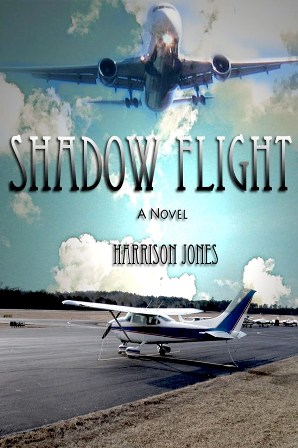
It’s a rainy day in Georgia, but I put on my author hat and went out promoting my book. Dropped by the post office and mailed a few autographed copies to folks who have honored me by investing a few dollars in reading entertainment. I’m praying that it’s worthy and they don’t demand their money back. Next, I dropped by two local libraries and donated books for their shelves, along with a stack of book marks for their patrons. I love libraries and bookstores and could spend days exploring the shelves. My last stop was at Falcon Field in Peachtree City. The photo used for the cover of Shadow Flight was taken on the flight line at Falcon Field and I thought the Flight School deserved a copy depicting their work place.  

Small airports are probably the friendliest places on earth and the atmosphere is almost always predictable; dedicated and passionate people doing something that they love while trying to eek out a living in the process. The good folks at Falcon Field are no exception and their students enjoy an excellent learning environment. Aviation is addictive and gets in your blood. Once you’re admitted to the fraternity, there’s no going back. Met some nice people today; maybe they’ll show up in the next book.   

Posted by: harrisonjones | July 13, 2011

He won’t come out of the toilet…

A United flight from Chicago to Germany had to divert to Cleveland yesterday because an unruly passenger would not stay in his seat and locked himself in the toilet. Now, I grew up in a house with seven people and one bathroom, so I know what it’s like when someone will not come out of the toilet. However, none of us ever had to be tackled and restrained to maintain order.  

I’ve mentioned the cost of diverting a flight before and it can be significant. Fuel, landing fees, extra crew cost,  and missed connections due to the delay, can eliminate any hope of making a profit on the flight. I’ve also mentioned that I think humans are the strangest of all the earth’s creatures, and I cite this incident as further support of that position. I mean, didn’t the man realize that he would be arrested and given his own little private space with a metal toilet bowl in the corner. At least he was smart enough to go to jail in the US, and not some third world jurisdiction.  

I offer two incidents from my exciting and colorful career as evidence that humans are strange. The first occurred when I was a brand new MD-88 captain and still trying to figure it all out. We were inbound to Dallas-FT. Worth and had just entered approach control’s domain. Bear in mind that being told to contact approach at DFW doesn’t mean that you will be landing any time soon, it simply means that you have been recognized as  a potential arrival for later in the day. However, I dutifully turned on the seat belt light because miracles sometimes occur. Shortly thereafter, the head mama called to tell me that a gentleman was in the lavatory and would not come out. I was not going to send the co-pilot back there and eliminate 50% of the eyeballs in the cockpit, while flying a crowded traffic pattern, and I was not going to leave the pattern and go back to Little Rock to get in line again either. When the flight attendant asked me what to do, I told her to sit down and strap in. She explained to me that we could not land with someone in the John, and I explained to her that we didn’t have enough fuel to outlast a case of severe constipation. I didn’t have time to explain my strange people theory to  her, but she readily agreed that we should land. I wish I could relate a logical conclusion to this episode, but when I left the airplane, the police were still trying to talk the man out of the lavatory. Our next flight was just  three gates away and we happily changed horses and sought new adventures.  

The second incident occurred at mid-Atlantic on a flight from Atlanta to Manchester, England. I was taking my  mid-flight break and napping in the cabin when the flight attendant woke me up early to inform me that a male passenger was walking through tourist and touching people as he moved past. Passengers were complaining and she had counseled the man to cease and desist. When he began his shenanigans again, she asked me to  speak with him. I invited him to the aft galley so as not to disturb the sleeping passengers and explained that he had no choice but to sit down and behave. He hung his head, apologized, and sat down. Remember that my  theme here is strange people. I returned to the flight deck and sent one of the co-pilots on break. An hour later the flight attendant (a salty lady of vast experience) came to the cockpit to share a cup of coffee with us and watch the sun rise. I asked if our weirdo was behaving and she said, “He is now.” 

I thought that required further comment and I asked her to elaborate. She said, “He walked past a big guy’s  seat and touched him on the shoulder and then the big guy reached out and touched him just below the right eye. He’s been quiet as a church mouse ever since.” 

I asked if she knew who hit him and she said, “Of course, I do.”

I asked if she was sure about that and she re-considered. “You know, I don’t think any of the crew saw who did it.” 

When we landed, she invited the guy with the left hook to leave the airplane first and he was long gone when the  Bobbies arrested the man with the black eye. We went to the hotel and he went to jail.

Posted by: harrisonjones | July 8, 2011

Bluewater Press offers summer book sale

The fine folks at BluewaterPress LLC are offering thirty percent discounts on books, including my newly released Shadow Flight.

Click on http://www.bluewaterpress.com to shop their catalog and pick up the bargains for your summer reading enjoyment. The support that I have received from Bluewater in publishing Shadow Flight has been outstanding and I hope you enjoy their catalog and take advantage of the bargains.

Don’t board that fourteen hour flight to Tokyo without a couple of good books to read. An airline pilot’s career includes literally thousands of hours sitting around pilot lounges, laying over in hotels, and deadheading in the cabin. I would have never survived without a couple of books in my bag at all times. Most of you have heard the analogy that flying is hours and hours of boredom, interupted by moments of sheer terror. All things being equal, I would just as soon get my excitement from a book.

Posted by: harrisonjones | July 4, 2011

New Shadow Flight excerpt…

Captain Bud Gibson hated recurrent training. The annual ritual of sitting in a ground school classroom for two eight hour days and then a third day in the flight simulator was a torture that he endured only because it was a required qualification to keep his job for another year. Thank God he had finished the two days in the classroom and could now sequester himself to his hotel room to memorize the endless data he would need to pass his simulator check ride.

            The last two hours in the classroom had consisted of a lecture by a corporate security representative on the multitude of possible terror threats against the airlines. The awareness made him wonder why he loved a profession that required him to be trained to handle any number of aircraft malfunctions, snow, ice, thunderstorms, wind shear, fog, mountainous terrain,  turbulence, and now terrorist that wanted to take over his airplane and make it a weapon of mass destruction. His faith in mankind had been altered by the lecture.

            These were the thoughts that occupied his mind as he rode the elevator up to his room. At least he would be able to return home to Dallas after the check ride tomorrow and enjoy a few days off with his family—assuming, of course, that he handled all the emergencies in the simulator to the satisfaction of the FAA. 

            When the elevator doors opened, he began the trek down the long corridor carrying his flight kit in his right hand. He had forgotten how heavy the brain bag could be since it was normally hooked onto his rolling suitcase. As he approached the room his mind was still occupied with thoughts of terrorist threats and he paid little attention to the woman fumbling with her key card at the room next to his.

            She looked up and smiled, “I hate it when I get locked out of my room.”

            “I know what you mean—let me try it.”

            He inserted the card slowly and got a red light for his effort. He inserted it quickly with the same result. “Well, that’s the extent of my expertise. Guess you’ll have to call the front desk and have them send someone up with a new card. There’s a house phone by the elevator.”

            “I know, but it doesn’t work and I hate to go all the way down to the lobby to get a new key. I wonder if I could use your phone.”

            He thought about it and assumed that she was a flight attendant attending training also. Late twenties, Asian features, long black hair, killer body, friendly smile.

            “Sure, assuming I can make my key work.”

            At his room the green light glowed, the lock clicked and he opened the door. She followed him in and the door closed as he set his flight kit down by the desk. He was aware that she was standing close behind him and then he felt the bee sting on the back of his neck. The room began to spin and his thoughts became fragmented. The one that he tried to hold on to was a vague recollection of something he had heard in ground school about crew awareness of hotel security.

Posted by: harrisonjones | July 1, 2011

Some days are bigger than others

The sun came up today and the birds chirped as they took to the air on a gentle summer breeze. Just  another Georgia morning with God in his heaven, spinning the good earth at 1000 miles per hour. However, the day is anything but normal at the Jones household.

Today, Shadow Flight is launched and available on the market. Questions abound. Will it be accepted? Will it be  deemed worthy? Will it be credible with the aviation community and will it be entertaining for the general public?  

If you read the book and find it lacking, please wait at least a week before telling me. If you think it’s a good read, please tell my publisher they didn’t make a horrible mistake by putting their name on it and tell Amazon it’s worthy of the market. There will be hundreds of other books released today also, and I wish their authors  well. 

This holiday weekend we celebrate our independence and remember our founding fathers that formed our  great nation. I am so very grateful to live in a country where books can be written and published without government censorship. Enjoy the holiday.  

Posted by: harrisonjones | June 26, 2011

Civil Air Patrol…Shadow Flight excerpt.

My novel, Shadow Flight, (July, 1 by BluewaterPressLLC) includes several scenarios involving the Civil Air Patrol. I have the greatest respect for this volunteer force and appreciate their devotion to aviation safety. Before reading the following excerpt, I want to remind you of the valuable services rendered by CAP. The organization was founded in 1941 by Congressional Act and provided coastal patrols throughout World War II. CAP is credited with sinking two German U-Boats and damaging many more. They are famous for their search and rescue missions, involving missing aircraft, but they are involved in many other important actions as well. The list  includes assisting Border Patrol; working with DEA in combating drug trafficking; interacting with the Forest Service; providing emergency services during natural disasters; assisting Homeland Security; and numerous other essential missions. CAP is very active in aerospace education and the Cadet Program, for youngsters between 12 and 18 years of age, insures that the aviation industry will be well staffed in the future. Enjoy the excerpt. 

Shadow Flight

At 8:20 the Cessna took off and turned to the southeast. Kyle activated the flight plan by radio as they climbed to 7500 feet on a direct course for Brownsville. They could not out climb the setting sun and soon the cockpit was  illuminated only by the dull glow of the instrument panel lights. Brooke was mesmerized by the hypnotic illusion of being suspended between the twinkling lights on the ground and the twinkling stars above them. 

            At 10:25 p.m. central time the FAA specialist at the San Angelo Flight Service Station picked up the phone and pushed the button that would connect him directly with the control tower at Brownsville-South Padre Island International Airport. The phone rang several times before a harried controller finally answered, “Tower, Nicolson speaking.”

            “Hey Nick, it’s Bill at San Angelo Flight Service. I’m looking for a Cessna November 3562 Echo. Did he close out a VFR flight plan with you guys?”

            “Hang on, let me check…man it’s nuts down here tonight…we’ve got a fur ball of airplanes in the pattern. No, I don’t have anything on him, Bill; we haven’t had any VFR closeouts in the last couple of hours. Was he landing here or one of the smaller airports?”

            “He was filed with you as the destination. He’s a little more than thirty minutes overdue.”

            “Wait one; I’ll see if we can raise him on tower frequency. What kind of airplane is it?”

            “A Cessna 172 squawking 1200.”

            A minute later the controller came back, “We tried him on approach and tower both with no response, but I’ve got plenty of 1200 VFR squawks on the screen, believe me.”

            “There’s a news flash. Okay Nick, I appreciate your help. If he shows up let me know right away.”

            “Will do, see ya.” 


The specialist had experienced many pilots forgetting to close out their flight plans, but he had a bad feeling about this one. He had taken the flight plan over the phone himself and the pilot seemed very professional and
experienced. He got out the notification list and started making phone calls. The first call went to the Air Force Rescue Coordination Center, who would in turn notify the Texas Wing of the Civil Air Patrol, and the U.S. Coast Guard. State and local police were also notified to be on the lookout. They would all be actively searching for Cessna N3562E when the airplane’s fuel exhaustion time came and went two hours later.
         

            The first search and rescue briefing was scheduled for shortly after sun up at McLane Field. Roy McLane had been notified at eleven o’clock the night before and told that one of his airplanes was overdue at Brownsville. He had not been back to bed. He had taken off at midnight and flew to Brownsville and back in search of Kyle’s flight. He had seen nothing in the dark to indicate a crash site and repeated calls on the radio had gone unanswered. The Civil Air Patrol had flown a sortie during the night as had the Coast Guard.

            Roy had just finished brewing a pot of coffee when the first radio call came. “McLane Unicom, Coast Guard Rescue One-Four, five miles out for a straight in final, Runway Three-Three.”

            Roy picked up the mic, “Coast Guard One-Four, McLane, wind calm, no reported traffic.”

            Roy didn’t realize it was a helicopter until he heard the whop-whop of the rotor blades. He keyed the mic  again, “Coast Guard One-Four, we don’t have a designated helipad, but the grassy area beside the hangar is clear and flat.”

            “Roger sir, thank you.”

            Thirty seconds later the radio squawked again, “McLane Unicom, Cessna November Eight-Nine-Six-Three Charlie, five miles south.”

            Roy answered, “Cessna Six-Three Charlie, wind calm, suggest Runway Three-Three. There’s a helicopter on short final.”

            Roy walked out to watch the chopper land and then saw the Cessna with Civil Air Patrol markings touchdown and rollout. Ten minutes later the three Coast Guard crewmen and the two Civil Air Patrol pilots were gathered in the airport’s lounge and consuming Roy’s fresh coffee. Five minutes after that they were joined by the county sheriff and two state troopers. When everyone was introduced, Roy led them into the flight  school’s classroom. The room featured two long tables with chairs and a huge aeronautical chart on the wall.

            Roy said, “Gentlemen, I really don’t know where to start. I can’t tell you how much I appreciate your being here and I want to do everything I can to help.”

            One of the state troopers spoke up, “The first thing we need to know, Mr. McLane, is who was on the airplane.”

            Roy answered, “The pilot is Kyle Bennett. He’s my flight instructor and charter pilot. He took one of his students along to fly copilot. Her name is Brooke Roberts and she’s the wife of Glenn Roberts, a well known local surgeon. Glenn is on his way home from Dallas. I called him last night with the bad news. The charter passenger is a Mr. Gomez.”

            Everyone was taking notes as Roy spoke and the trooper asked, “Do you have any information on Mr. Gomez?”

            “We require ID on all our passengers, but all I have is a copy of his driver’s license.”

            “Okay, I’ll need a copy of that too.”

            “I’ll make you a list of all their names, addresses and phone numbers.”

            “That would be great. All our troopers have been notified and are on the lookout for the airplane.”

            The sheriff spoke next, “All our deputies have been advised also.”

            One of the Civil Air Patrol pilots was the commander of the San Angelo squadron, “Mr. McLane, we have two airplanes in the air right now and more on the way. Each one will have at least one observer as well as the pilot. I want to get airborne again as soon as possible myself, but I need to go over the flight plan with you before I do.”

            “I’ll give you what information I can, sir.”

            “This is what the FAA gave us last night. The airplane is a red and white Cessna 172 equipped with a transponder. We assume he was squawking a code of 1200 for radar surveillance and had three souls on board. He reported off McLane Field at 8:20 local with an ETA at Brownsville of 9:53 local. He filed a cruise altitude of 7500 feet and a direct route to destination with a little over four hours of fuel on board.”

            Roy confirmed, “That’s all correct and I can tell you that Kyle is an excellent pilot. I can’t imagine what could have happened.”

            “I know the airplane is required to have an emergency locator transmitter, Mr. McLane. Do you know when it was last tested?”

            “We recently upgraded to a new model ELT with satellite capability. It transmits on all three emergency frequencies. The signal should have been picked up right away.”

            The Coast Guard pilot asked, “Did they have water survival gear aboard?”

            “No, we don’t usually carry the raft, unless it’s required, because of the extra weight. I’m sure Kyle didn’t plan on going out over the Gulf.”

            “I’m sure you’re right sir, but we’ll cover that possibility in our search just in case.”

            The CAP pilots were looking at the wall chart, “We’ll concentrate our search initially in the rural areas along and either side of a direct line between here and Brownsville. If they went down in a populated area someone would have reported it.”

            The sheriff said, “It should be pretty easy to spot something as big as an airplane.”

            The CAP commander answered, “We normally don’t look for something as big as an airplane, sheriff. A crash site usually looks like someone dumped a truck load of trash in the woods. Sometimes you can put most of the pieces in your pocket. It can be a pretty gruesome sight from the air, but our ground crews are the ones who suffer nightmares.”

            The sheriff replied, “I can relate to that. I know you folks are all volunteers and I appreciate what you do.”

            The pilots were anxious to get back in the air and after dividing the search area between the CAP and the Coast Guard, everyone prepared for a long and grueling day. Another CAP airplane arrived and delivered a ground coordinator who would remain at the airport with Roy to coordinate the search effort. The pilots would stay in touch and make their reports via radio or cell phone.

Posted by: harrisonjones | June 20, 2011

What if…

How many times have you asked yourself; “What if?” Pilots asked themselves this question constantly when  planning or conducting a flight. What if the weather changes? What if I have mechanical problems? What if I lose communications? What if someone on board becomes ill or has a heart attack? What if I lose my Nav system? 

A professional pilot will try to solve as many questions as possible before strapping into the airplane and then   re-evaluate as the flight progresses. I use the term professional pilot to define an attitude, not one’s status in the industry. I have known private pilots who are just as professional as airline captains. Student pilots learn early on that pre-flight is not just walking around the airplane and kicking tires. It involves answering the, “What ifs?” Sometimes a pre-flight becomes a no-flight and that’s a good thing. 

The answer to many problems in flight is to simply land the airplane at the nearest suitable airport. If you’re  flying a J-3 Cub, that would be any airport. If you’re flying anything that begins with Boeing, you’re going to have to be more selective. Off schedule landings are bound to happen if you fly on a regular basis and I’ve had my  share. The first such occasion was while flying a charter in a Cessna. After dropping my passenger off, I was flying through the Confederacy and returning to Georgia when I encountered the infamous afternoon and evening thunderstorms that the south is famous for. I happened to be over the arm-pit of the nation at the time and I won’t identify the state that I assign that distinction, but the airport I retreated to was Anniston. By the time I re-fueled the airplane and myself, the storms had moved beyond my destination and once again  discretion triumphed over valor. 

All my diverts in Boeings were due to medical emergencies or doing circles in a holding pattern until the fuel gauges told us it was time to visit the alternate. All my fuel diverts were successful, but unfortunately some of the medical emergencies did not end as I had hoped. Perhaps a blog for another day. 

The question, “What if,” is also the basis of writing fiction. As an author, I ask myself that question and then develop a plot that answers it in what I hope is a suspenseful and entertaining way. The questions I ask myself as an author are some of the same ones I asked myself as a pilot. What if I had an emergency at the equal time point of an ocean crossing? What if I had an emergency in a non-radar environment with no way to communicate? What if I was forced to use my aviation skills in a way that would vilify my reputation as a pilot? It’s much more fun answering those questions sitting at a laptop than it was sitting in the left seat. It’s also nice to know that if I don’t like the outcome or I’m not happy with my performance, I just use my delete option and start over. The only “do overs” you get in the real world are in the simulator and you’ll probably get very few before receiving the, “Do not pass Go. Do not collect a pay check,” notice. 

The good thing about solving problems at my laptop is that the FARs do not apply. What if…

Posted by: harrisonjones | June 15, 2011

Airline baggage fees…

The airlines have started charging a fee for carrying your bag. The explanation seems to be that the weight of your bag causes the airplane to burn more fuel and fuel is expensive. Well, I don’t think we can argue with the science of that explanation so I thought I would examine the economics. I mean if they’re going to charge by the pound, why don’t they weigh us at check in and charge accordingly. I would fast a few days to get a cheaper ticket. Anyway, here’s the math. 

For an example, let’s examine a flight from Sao Paulo, Brazil to Atlanta. I chose this example because my novel,  SHADOW FLIGHT, involves just such a flight and the more times I see the title of my book on the internet, the  better I sleep at night. The question is; how much does it cost to transport a fifty pound bag? I used an actual flight plan that I found in the bottom of my flight kit among the tootsie roll wrappers. The takeoff weight of the airplane (a MD-11) is 602,562 pounds. Somewhere in there is your 50 pound bag. The block fuel is 217,500 pounds with a target arrival fuel of 44,376 pounds. We’re going to have to pay for 173,124 pounds of kerosene. The Brazilians are happy about that. At 6.7 pounds per gallon, we’re dispensing of 25,839 gallons of fuel at  $2.62 per gallon. $67,698 goes on the Visa card. By dividing the dollars into the takeoff weight, it appears that it cost $1 to move 8.9 pounds. The fuel cost of your 50 pound bag is about $5.60. 

To be fair to the airline, there are many costs other than fuel involved and this is a nine hour flight. The longer  the airplane stays at cruise altitude the cheaper the fuel bill per hour. The jet engine loves the cold air at altitude and operates more efficiently. Also the air is thinner and it takes less thrust to overcome the drag. The highest  fuel cost is during the climb to altitude and maneuvering or holding at low altitudes during the arrival. 

For example, the 16 minute climb to cruise altitude on this flight burned 12,512 pounds of fuel. The same 16  minutes at cruise altitude only burned 5456 pounds. As you can see, short flights are much more expensive per hour than long haul flights. 

All this math is making me dizzy, but I hope it provided more insight than the newspaper articles.   

Posted by: harrisonjones | June 10, 2011

Equal Time Point excerpt

Someone asked me today if my new novel featured any of the characters from my first book, Equal Time Point. There are a few common characters and in the following excerpt, from Equal Time Point, Captain Charlie Wells and Flight Attendant Britt Johnson also appear in Shadow Flight. The scene is the initial portion of a trans-Atlantic flight from Atlanta to Madrid, Spain. The calm before the storm so to speak.

EQUAL TIME POINT

            The flight benefited from a forty knot following wind, and sped rapidly to the east as the sun dipped lower in the sky behind them. The air was clear and smooth and Charlie and Robby chatted and enjoyed the view.

            “Tri Con Eleven, contact New York Center on 132.85.”

            “Three-two point eight-five, Tri Con Eleven, so long.”

            “Good evening, New York, Tri Con Eleven with you level at three-three-zero.”

            “Tri Con Eleven, New York, good evening sir. How’s the ride?”

            “It’s been real smooth so far. Have you had any reports?”

            “Yes sir, you can expect some light to moderate at three-three-zero once you pass JFK.”

            “Thanks for the warning.”

            Charlie had been watching flashes of lightning in the distance for the last hundred miles or so. “I guess the forecast was right about the scattered thunderstorms.”

            He turned on the radar, extended the range, and adjusted the antenna tilt down slightly. The screen painted a line of thunderstorms extending to the northeast of JFK. They were separated by forty miles or so and each one featured a red center of heavy rain surrounded by a larger area of green or yellow indicating lighter precipitation. He transferred the image to the NAV screen to see exactly where the storms were in relation to their planned course.  “Looks like they’re scattered along the beach. We should be able to deviate a little to the right and miss them. We’ll wait till we get closer.”

            The lights on the ground were beginning to define cities that were not apparent in sunlight from thirty-three thousand feet. The clouds beneath them were scattered to broken now but a few minutes later Charlie could clearly see Manhattan and New York Harbor as they approached.

            “Robby, why don’t you play tour guide and tell the people about the Big Apple?”

            Robby punched the PA button and gave the announcement that he had repeated a hundred  times before. “I hope I didn’t wake Tony.”

            “Yeah, there’s a lot of reasons why nobody likes first break. Let’s see if they’ll let us go right for a little while, Robby.”

            “New York, Tri Con Eleven, we’d like to deviate right to miss the boomers up ahead.”

            “Tri Con Eleven, deviate right of course as necessary, let me know when you can go direct Boston.”

            “Tri Con Eleven, will do, thank you sir.”

            Charlie selected a heading twenty degrees to the right and pulled the knob that changed the autopilot mode from Nav to Heading. The interphone chime sounded and Robby answered, “I asked you not to call me at work.”

            Britt said, “You and Alice should team up and do a nightclub act. Are you gentlemen ready to dine?”

            He looked at Charlie and got a thumbs up. They had already perused the menu and made selections.

            “Yes ma’am, one beef and one chicken.”

            “How about beverages?”

            “Do you have a nice Chardonnay?”

            “Of course, would you like a couple of tequila shooters to go with it?”

            “Maybe later when the boss goes on break. For now just a couple of bottled waters.”

            “Give me a few minutes, I’ll call you back.”

            Charlie turned another five degrees to the right and watched Mother Nature’s light show with the cloud to cloud lightning over Long Island.

            “Tri Con Eleven, traffic at one o’clock, two-zero miles, a Boeing 747 at flight level three-one zero.”

            “We’re looking.”

            Charlie reached up and turned on the bright white fuselage lights and as they looked ahead they saw another bright set of lights illuminate on the 747. The twenty miles was already less than ten with a closure rate of over a thousand miles per hour between the two airplanes.

            “We have the traffic in sight, Tri Con Eleven.”

            “Roger sir.”

            “He must be deviating too,” said Charlie.

            They confirmed the other aircraft’s altitude on their TCAS indicator and watched him disappear under the nose. Robby wrote down the time and fuel abeam JFK and announced that they were making time and fuel. They were now one minute late and only down six hundred pounds of fuel.

            The interphone chime sounded again and Britt gave the password to enter the cockpit. Robby pushed the unlock button and when the door opened they could smell hot food. Britt and Pat brought the trays in and Charlie placed the aircraft log book on his lap and set the food tray on it. He had learned long ago that the trays often had food on the bottom where they had been stacked on top of each other. The logbook saved embarrassment and cleaning bills.

            Pat asked, “Was that really New York a few minutes ago or are you guys making stuff up?”

            Robby said, “We’re not positive but it sounded good, don’t you think?”

            “If I didn’t know you Robby I would probably believe it.”

            Britt asked, “Are we on time so far?”

            Charlie said, “We’re one minute late but we’re working on it.”

            “Tri Con Eleven, contact Boston Center 134.55.”

            “Three-four point five-five, Tri Con Eleven, good night ya’ll.”

            Robby enjoyed calling New Yorkers ya’ll.

            “Boston Center, Tri Con Eleven at three-three zero, deviating east of course for weather.”

            “Tri Con Eleven, Boston, radar contact, deviations approved, let me know when you can come back to the left.”

            “Will do, sir.”

            Charlie said, “That’s Providence, Rhode Island over there.”

            Pat said, “How do you know?”

            “Because, it says PVD on my navigation screen.”

            “Sounds like men’s underwear to me.”

            “That’s BVD, Pat.”

            “I thought you said it was Providence.”

            “You’re right, we’re lost.”

            “I thought so.”

            Britt said, “You two sound like Abbot and Costello doing ‘Who’s on first.”’ I’m getting dizzy; let me know when to pick up the trays.”

            Pat said, “I’m leaving too. When you finish dinner, try to find out where we are.”


            Allen had turned his video screen to the Air Show and asked Molly, “Are these guys lost? Why are we over New York if we’re going to Spain? Why didn’t we just go straight east across the Atlantic?”

            “New York is east of Atlanta, Allen.”

            “Well, I’m not sure but I think a straight line is the shortest distance between two points.”

            “You can’t draw a straight line on a round ball, Allen.”

            He paused to think about that and looked out the window, “Look, they just turned on the outside lights; that doesn’t make any sense at thirty-three thousand feet.”

« Newer Posts - Older Posts »

Categories