Posted by: harrisonjones | May 2, 2011

Why did I say yes…

I have been asked to give a thirty minute motivational presentation on customer service tomorrow. The fact that I’m blogging instead of doing an outline should tell you that I have no clue how to do that. What was I thinking? My only qualification is that I am a customer every time I walk into a local business.  

Wait a minute; most of those establishments have lousy customer service. Maybe I can work that angle. This is not a fortune 500 company that I am speaking to. They only have about 20 employees, but doesn’t that make each of them critical to success? Wow, I would like to think that I was one of the 20 most important employees of a company. Let me write that down. 

I suppose every company provides a product or service and it is what it is, but it’s how that product or service is delivered that defines customer service. Whoa! Dude! I’m rolling. What were those things I learned as a flight instructor? Authority, responsibility, accountability, credibility, perception, motivation, something about promoting someone’s self image, integrity. Oh baby, I gotta go and write this down before it evades me.

Oh yeah; I said yes because I get a free lunch. If it goes well, I’m ordering double fries. Wish me luck.  

I got a great opening. Ladies and gentlemen…
Posted by: harrisonjones | April 25, 2011

Write or wrong…

Someone asked me yesterday how difficult it was to do the research necessary for a novel. I think that’s why all the experts suggest that you write about what you know. I do think accuracy and credibility are important, even in fiction, and I try to describe the scenes in my books as realistically as possible. Of course, every laptop contains a complete research library and I Google anything I want to know from the comfort of my writing lair.

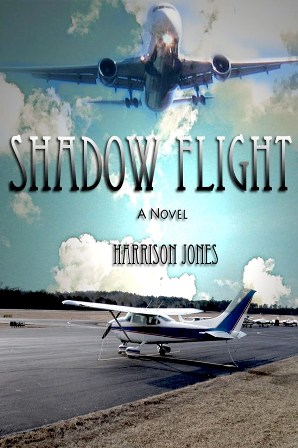
One of the scenes in Shadow Flight takes place at a small airport in Socorro, New Mexico. I started my research with a low altitude Jeppesen en-route chart to study the airways and restricted airspace in the area. Next I used Google earth to study the area and surrounding landmarks visually. I simulated a virtual visual approach by zooming in. Then I Googled the airport its self and found a nice photo of the little terminal building at midfield. I would like for you to think that I spent days researching this, but it was less than fifteen minutes. 

Even the technique is not original. Certain airports around the world require special qualification before an airline pilot can operate there. Zurich comes to mind because of high terrain and some really unusual engine out procedures for takeoff and the missed approach. By watching a video much like what I described for Socorro, a captain can sign himself off for the qual.  

Other very useful tools are training aids. When an airline pilot checks out on a new aircraft, he or she attends a two week ground school followed by several simulator sessions before taking the rating ride. One of the training aids that is issued is an interactive DVD of the airplane’s flight management system and autopilot interface. When I write a scene involving a flight, I simply insert my DVD and program the flight plan, including fuel load, passenger load, departures, arrivals, cruise altitude and whatever. I can sit back and watch my laptop fly the entire ten hour flight in real time or I can move it forward to any point I choose. It always makes a perfect auto land. The FMS will tell me the estimated time and fuel for any point along the way.  

The truth is that accurate technical information is pretty much a given for any writer who chooses to use it. I can only hope that my imagination weaves it into a story that is entertaining. 

 The fact is that a general audience is more interested in the story than the tech data and I include only enough to make it credible for pilots who read it. Where’s my DVD? I think I’ll fly to Paris today.     

Posted by: harrisonjones | April 23, 2011

First Lady…you’re number two.

Another disaster somehow avoided. My newspaper tells me that the First Lady narrowly escaped tragedy when air traffic controllers vectored her flight to within 2.9 miles of a heavy jet on approach. Say what… 

Don’t get me wrong, this was an obvious mistake and one that will be hard to explain. Life threatening? Hardly. Let’s see if we can set the scene. Heavy jets (max gross landing weight 250,000 pounds or more) create wake turbulence that require following non-heavy jets to maintain five miles in trail. A good rule that should have been enforced in this situation. However, wake turbulence descends shortly after being created at each wingtip and as long as the following flight stays above the heavy’s flight path, he will not encounter a problem.  

I promise you, similar situations occur every day at busy airports worldwide and seasoned pilots and controllers know how to play the game. It goes like this. 

“Flight 1 heavy, you’re cleared to land.”

“Flight 2, you’re following a heavy jet at twelve o’clock and five miles.”

Now the game begins. If Flight 2 says he has the traffic in sight, the controller will clear him for a visual approach and the pilot will become responsible for his own separation. Probably not going to happen. The captain sees the heavy, but responds, “We’re looking.”  

The TCAS (traffic collision and avoidance system) now says four miles but nobody mentions it.  

“Flight 2, reduce to minimum approach speed.” Flight 2 complies and also goes a half dot high on the glide slope to stay above the heavy’s path.

“Flight 1 heavy, expedite if possible, you have traffic in trail.”

If Flight 1 is truly heavy, he is not going to speed up. He needs the entire runway to get stopped as it is.

“Flight 2, S turns to the right are approved for spacing.”

The game continues until the controller or the captain decides to start over. Bear in mind that as long as the trailing airplane stays above the glide slope, there is no danger. 

Another point to remember is that the captain can initiate a go around anytime he chooses. The missed approach airspace is always protected and available to him. He doesn’t need to ask. Playing the game is fine, but no captain is going to take a chance just to make the system work. I’m sure the First Lady’s flight crew was controlling a safe speed and doing smooth S turns while remaining above the glide slope. If this is a news story, it could be published every day at every major airport in the world. Let’s do a 360 and get out of here.      

Posted by: harrisonjones | April 22, 2011

That’s not true…

Duh…it’s a novel. Of course it’s not true, it’s fiction. When I do public book signings, someone invariably asks me if the book is true. The next question is always, “Why do you write fiction?” The official answer is that I enjoy exercising my imagination, but the truth is it’s an opportunity to legally and ethically prevaricate. I can embellish without guilt. I can create characters and mold their personality. I control what they say and do and I can punish, reward or exact revenge at will.  

I am not without supervision, however. I once killed a character in mid-novel and my wife (Love of my Life) moved my Teddy Bear to the couch until I edited the lady back to life. So much for artistic license.  

Another question is, “Where do you find your characters?” Sometimes they’re loosely based on a real person, sometimes they are a combination of real people, and sometimes they are totally made up. In order to characterize, I simply observe people in their natural environment. I note their posture, how they walk, facial expressions, mannerisms, how they dress, how they express themselves etc. I once followed an attractive lady through the grocery store, noting traits for characterization. When we got home, Love of my Life domiciled my Teddy Bear on the couch again. Creativity does not come without a price.  

Another question I often get is, “Can my twelve year old read the book?” The answer is yes. I am not offended by R rated books or movies and real life is what it is, but I choose to write in G. My books are not about kids, they’re written with an aviation oriented adult audience in mind, but if a kid reads them, I hope their imagination will be stimulated in a positive way.  

Okay, what shall I write about this afternoon? What if…what if the Civil War had been fought with J3 Cubs with 85 horsepower engines? Let’s see…as the smoke cleared, a yellow blur emerged low and…

Posted by: harrisonjones | April 21, 2011

Lessons learned from flight instructing

The first time I sat in an airplane, with the premeditated intention of committing an act of aviation, the instructor at my right elbow was James H. Phillips. Neither of us knew that he would still be my instructor years later when I passed my Airline Transport Pilot exam. Words like basic and minimum standards were not in Jim’s vocabulary. He set the highest standard for himself and expected no less from his students. The way he flew an airplane was a true melding of art and science. 

When Jim put me through the CFI program, I did not envision myself teaching as a profession. My goal was to simply become a better pilot and the training itself would put hours in my logbook. I was overloaded just trying to learn to fly from the right seat and his lectures about the psychology of how people learn, and what motivates them to do so, was not an exciting part of the program. As I look back now, I realize that understanding how humans communicate and respond was the most important thing to know and it had nothing to do with airplanes.  

When I took the FAA for a ride and they declared me a Certified Flight Instructor, I began with my first student a few days later. My education was just beginning. I soon discovered that the first step in the process was to gain the students confidence and the way to do that was not to dazzle them with my vast  knowledge of all things aeronautical. The phrase, “They don’t care how much you know until they know how much you care,” comes to mind. I found that demonstrating character and integrity produced the credibility I wanted; a life lesson that has rewarded me in many situations over the years. 

Gaining someone’s confidence can be a dangerous thing. The power to motivate and influence is a necessary tool in teaching, and in life, but the abuse of that power is the subject of headlines almost every day. Did I mention character and integrity? I could offer examples, but I refuse to discuss politics. I suppose that the lesson learned is the triangle of authority, responsibility and accountability. If you can’t handle all three, don’t play the game. 

I promised myself that I would shorten my blogs, so let me sum this up by saying that my one student became twenty within a few months and I learned much more than I taught. Life lessons about human nature and the fact that it never changes. Cave men sought warmth and security. They built a fire in the cave and rolled a rock in the opening. Tonight you will adjust the thermostat and set the alarm. Same desires, same needs, same motivations. Understanding people, the key to success in any field of endeavor.  Is it possible that some of the problems we face in aviation today have more to do with humanity than aerodynamics?

Posted by: harrisonjones | April 18, 2011

THE REST OF THE STORY…

Since I blogged on air traffic controllers yesterday, I suppose it’s only fair to discuss the other side of the equation. After all, wasn’t a pilot crew accused of snoozing past MSP last year. Let me make it clear that I am not qualified to criticize anyone. My own blunders and ineptitude removed me from that lofty perch long ago. However, fighting fatigue is a battle we all contend with sooner or later. Just to offer a little perspective, consider that when you snuggle down under the covers tonight after your milk and cookies, there will be thousands of air traffic controllers, pilots, flight attendants, mechanics and other airline personnel just beginning their work day. Some will have had eight hours sleep and some will have had none. 

I read in the paper this morning that Randy Babbitt, the FAA Administrator, has decreed that controllers will now have nine hours between shifts instead of eight. Where do we find men of such vast intellect? Oh yeah, I just remembered, Randy was the president of ALPA (Air Line Pilots Association) when I was rubbing my eyes and flying midnight rockets. The regulation was that we had to have eight hours free of duty between flights. See yesterday’s blog. Example; arrive Las Vegas at three p.m., report for duty at eleven p.m. for an all nighter to New York. Try to cycle that through your diurnal. You pray for a good strong copilot, lots of hot coffee and hope you don’t have to land to the east with the sun coming up. The standing order for the copilot was, “You better not let me wake up and find you sleeping.” 

International flying rules are more realistic. Flights scheduled for more than eight hours require an extra copilot. This allows each pilot to have a two to three hour nap during the flight. Flights of more than twelve hours require four pilots; two captains and two copilots. Most airlines provide a crew rest facility that features bunk beds and privacy curtains. More than likely the captain has shed his pilot costume for sweats and a tee shirt. If that sounds like fun, let me describe one of my seven day duty rotations. Short and sweet; Atlanta, Tokyo, New York, Tokyo, Atlanta. The first leg is fourteen to fifteen hours. Leave Atlanta at ten a.m. arrive Tokyo at noon. However, you crossed fourteen time zones and the International Date Line. Its noon tomorrow but your body is telling you it’s midnight. The sun never went down and it won’t for another eight hours. No problem, you have a twenty four hour layover. The next day you leave Tokyo in early afternoon. You fly all afternoon, all night and most of the next day. The sun is going west at a thousand miles an hour and you are going east at about six hundred. The sun goes down and comes back up like a yo yo. You are near the Arctic Circle and the world is not very big around anyway. Arrive New York in the afternoon yesterday. Your body has no idea what time it is or what day it is. Only five more days to go. The only way to survive is to take a nap and eat every four to five hours until you get home. 

My longest day ever on an airplane was twenty four hours. I left Frankfurt about midnight, accompanied by my good friend and fellow captain, Bob Foster along with two copilots. We flew a military charter to Kuwait City and parked in a remote area. The airport was complete chaos with priority military flights and we waited all day for fuel. At last a little fuel truck started running back and forth to the fuel farm to fill us up. We finally got clearance and hauled back to Frankfurt empty, arriving at midnight once again.  

I wish each of you a good night’s sleep tonight. Babbitt, if you’re reading this I don’t want to hear anything about crew duty rules on charter flights.

Posted by: harrisonjones | April 17, 2011

You’re cleared to…ZZZZZZZ

Sweet dreams and flying machines. Ahh, James Taylor was ahead of his time. It seems that a few thousand years ago our ancestors decided that humans should endeavor during the day and sleep at night. This probably had something to do with the fact that they kept stubbing their bare toes while wandering around in the dark. A few years later someone discovered fire (probably some copilot’s ancestor pushing buttons just to see what would happen) and illuminated the night for nocturnal activities. Still, our diurnal cycle (not that…I’m talking about a sleep pattern) dictates that we sleep at night. 

Now that I’ve enlightened you with the undisputed scientific facts, let’s all assume a holier than thou attitude, as humans are prone to do, and criticize the air traffic controllers who have been snoozing on their stool. (Pardon the unfortunate mental image). Let’s keep in mind that he is doing what is known as a double back. He got off work at four in the afternoon and is back in the tower at midnight for a solo shift. So what, he had eight hours to sleep, right? Well, kinda. It took an hour to drive home, and then he had to eat dinner. In bed by seven with the sun still shining bright through the drapes—toss and turn for awhile, double check the alarm clock. Ten p.m., up and at em. Shower, shave, brush your hair and comb your teeth, a quick breakfast and out the door by eleven for the hour drive to work. This is a piece of cake. 

All alone now at four in the morning. The tower is quiet but at least it’s dark and warm and cozy. No airplanes in sight for the last three hours. This is the time of night that military attacks begin because the enemy is least perceptive. The controller’s primary duty is to separate traffic. Uh…there is no traffic. The pigeons roosting below the cab ignore his commands and bump butts at will. Even if an airplane shows up, there will be no one to separate him from.  He considers another cup of coffee, but his bladder feels like a basketball already. Is there a restroom in the tower? 

Criticize all you want. Fire the guy, lock him up, or deport him. I’m just saying… Let me remind you that there are thousands of airports in the US that airplanes take off and land at with the tower unmanned at night. I included one of those in my novel, Shadow Flight. (Forgive the solicitation) In fact I have safely landed 767s full of passengers at those airports many times without the aid of a controller, sleepy or otherwise. There is a common traffic advisory frequency published for those fields and pilots report their position and intentions in the blind for any other flights in the area. The news reports about the controllers sounded like a near tragedy was averted. Personally, I would not have been in panic mode.

Posted by: harrisonjones | April 15, 2011

What if the roof blows off?

Can you imagine sitting in a Boeing Fluf (fat little ugly football) at 35,000 feet and watching your complimentary peanuts fly out the roof? If you’re an aviation expert, read on and add to the discussion. If you’re just a normal passenger, who ignored the safety briefing, maybe I can offer some insight and generate some questions. 

Why are airplanes pressurized?

We, as human beings, need oxygen as well as the complimentary peanuts to survive.  The percentage of oxygen in the atmosphere at 40,000 feet is the same as it is at sea level, however we require a level of barometric pressure to force oxygen into our lungs to be processed and that pressure does not exist at altitude. Barometric pressure is what the weather person reports on the 6 o’clock news every night and we usually ignore. That pressure normally equals about 15 pounds per square inch at sea level. Didn’t realize that you were carrying around 15 pounds of air on each square inch of your body? No problem we’ve adapted to it. The weather person expresses it in inches of mercury and the norm is 29.92 at sea level. Enough technical stuff already, back to the problem. When the airplane goes up, the atmospheric pressure goes down and we just can’t live without it. 

How does it work?

As one of my instructors used to say when asked that question, “Works good, last a long time and is easily cleaned with a damp cloth.” The problem is solved by pumping compressed air into the cabin to maintain the pressure. Where do we get the compressed air? No problem, the jet engine draws air in (Humans too if you get too close) and compresses it, mixes it with fuel, ignites it and the heat expands it and forces it out the tailpipe. The process is summed up in four words for pilots. Suck, squeeze, burn and blow. Works good, last a long…  We just bleed some of the air off the compressor section; pipe it through an air conditioner and out the little outlet above your seat. The system provides about 8.5 pounds per square inch at cruise altitude and the cabin altitude remains at 8000 feet or less. 

Now what happens if the roof splits open?

All our compressed air goes out the hole like a busted balloon and takes our peanuts with it. Somewhere it’s raining peanuts. Now you’re living in the rubber jungle. When the cabin altitude exceeds 10,000 feet, all the oxygen masks fall from the ceiling and hang there on rubber tubing. A point worth remembering! The safety briefing encouraged you to pull the mask to the full extension of the tubing before placing it on your face. That’s because the tubing has a string attached to it and when you pull the string it trips a switch to activate the chemical oxygen generator above your seat. There’s one unit for each row of seats and one extra mask in each location in case a child is riding in their mother’s lap. Two kid’s in one row? Bad juju. Just hope you have a sharp flight attendant who moves one of them before takeoff. Place the mask over your nose and mouth and breathe normally. That’s what the doctor said right before he removed my appendix. The oxygen is continuous flow and under pressure to force it into your lungs. It will last 10 to 15 minutes. 

Now what?

Enjoy the oxygen and tighten your seat belt, you are about to be transported to 10,000 feet very rapidly. The captain is required to execute the emergency descent without reference to a written checklist. Don the oxygen mask, retard the throttles, extend the speed brakes and lower the nose until the airspeed is on the little red line on the indicator. Pray that there’s not a thunderstorm or a mountain below you. (Save that for another blog) Keep your elbows out of the aisle because if the beverage cart is in use it will be headed for the front of the airplane very quickly. You might watch for flying laptops and other missiles also. 

I’m new at this and I realize it’s too long and too technical, but I’ll work on it. See you next time.  

Posted by: harrisonjones | April 13, 2011

Harrison’s Blog

Welcome to all who click. I hope you will visit often and join the discussion. My posts will primarily concern my great interest in aviation and writing. I’ve been fortunate enough to enjoy a forty year career in aviation and recently my interest in writing has resulted in two published novels (the second to be released soon). It seems that you can seldom read a newspaper or watch the evening news without encountering an aviation story. The roof of an airplane ripping open, an air traffic controller falling asleep, a flight attendant pouring a beer on someone and popping an escape slide, the ongoing TSA saga, birds in an engine and the airplane in the river, an airplane coming apart over the ocean, exploding underwear…you get the idea. My wife is tired of me blabbing so I’m going to try blogging. Hopefully it won’t be a secret blog (one that no one knows about).

I’ve just put the website up and I’m still trying to figure it all out, but I’ll post something tommorrow and hopefully generate comments for discussion and questions to find answers for. Meanwhile, snoop around the website and visit the other pages and tell me what I screwed up building it. What happens if I click here…oh #!?:#$+^ 

« Newer Posts

Categories